
Why Modern Songwriters Need Production Skills Before the Demo Stage
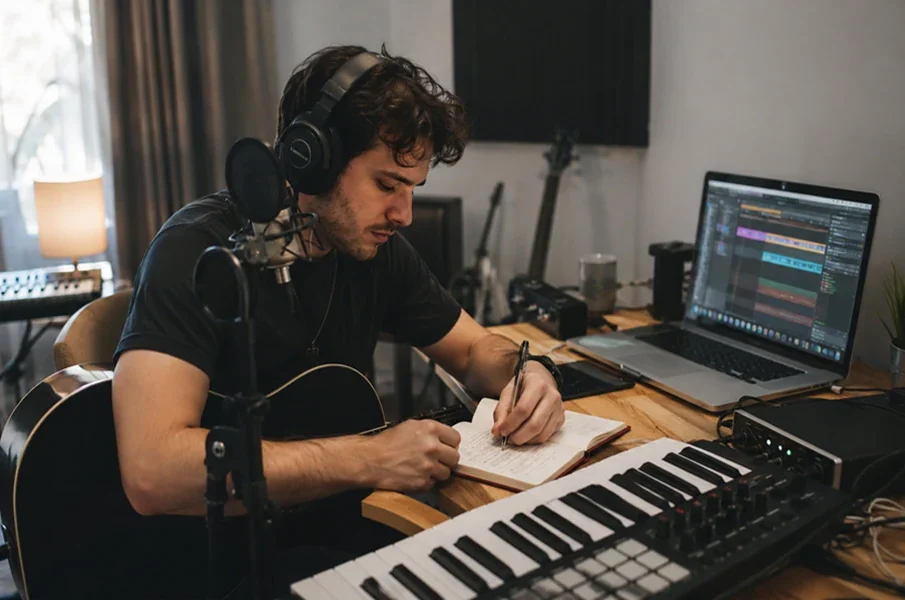
A song can begin with almost nothing: a lyric in a notes app, a melody recorded into a phone, or a few chords played late at night. But turning that initial idea into something another person can fully understand often requires more than finishing the words and harmony.
Production choices can influence how a song communicates long before the final recording begins. For developing songwriters, learning to think about arrangement, sound, dynamics, and recording during the writing process can make it easier to turn promising ideas into convincing songs.
The Song Is More Than Lyrics, Melody, and Chords
Lyrics, melody, harmony, and structure remain central to songwriting. Production does not replace those foundations. Instead, it determines how many of those ideas are presented to the listener.
Imagine a chorus that is supposed to feel larger than the verse. The songwriter could accomplish that partly through melody and harmony, but arrangement choices also matter. Adding vocal layers, changing the rhythmic pattern, widening the instrumental texture, or allowing the bass to become more active can all reinforce the emotional change.
The same principle applies in quieter moments. Removing instruments before an important lyric may make the line more noticeable. Delaying a drum entrance can build anticipation. Changing the register of an instrument can give a section more room without rewriting it.
Thinking this way encourages songwriters to ask not only, “What comes next?” but also, “How should this section feel when someone hears it?”
That question bridges songwriting and production naturally.
Production Decisions Often Begin During the Writing Process
One common mistake is treating songwriting and production as two completely separate stages: first write the song, then hand it over to production.
That approach can work, but the boundary is often less clear in practice. A sound can inspire a melody. A drum groove can change the phrasing of a vocal. A particular instrumental texture may suggest that a pre-chorus should be shorter or that the final chorus needs an additional section.
For writers who want greater control over how their ideas develop, learning both disciplines can be useful. A structured songwriting and production program can provide one route for developing composition and recording skills together rather than learning each process entirely in isolation.
The goal is not for every songwriter to become a specialist mixing engineer. It is to understand production well enough to make intentional creative decisions and communicate those decisions clearly when collaborating with others.
That distinction matters. Technical knowledge should support the song, not become the reason the song exists.
Build a Repeatable Write-to-Demo Workflow
A practical workflow can prevent production from distracting from the underlying composition.
Start by capturing the central idea as simply as possible. Record the melody, lyric, chord progression, or groove before worrying about polish. The first objective is preservation, not perfection.
Next, develop the structure. Decide where verses, choruses, pre-choruses, bridges, instrumental passages, or other sections belong. At this stage, listen for momentum. If a section feels too long, production tricks are unlikely to solve a structural problem permanently.
Once the basic song works, create a rough arrangement. Consider which instruments are actually necessary and what role each one serves. Does a guitar establish rhythm? Does a keyboard fill harmonic space? Does a backing vocal strengthen a hook? Every layer should have a reason to be there.
Then record a working vocal and enough instrumentation to communicate the song clearly. This version does not need to sound like a commercial release. It needs to reveal whether the writing and arrangement are doing their jobs.
Finally, listen away from the recording session. Distance can make problems easier to hear. You may discover that the intro takes too long, a lyric feels awkward when sung, or the second verse does not add enough new information.
Revision is part of songwriting, not evidence that the first attempt failed.
Know When Production Is Hiding a Weak Song
Production tools make it possible to add layers, effects, edits, and processing almost indefinitely. That freedom can become a problem when every weakness is answered with another sound.
If a chorus lacks impact, adding more instruments may not be the best first solution. The melody itself might need a stronger shape. The lyric may need a clearer focal point. The transition from the previous section may be too predictable.
A useful test is to reduce the song temporarily. Play it with one instrument, or listen to a stripped-down version of the vocal and basic harmony. Ask whether the important sections still feel distinct and whether the emotional progression remains understandable.
Not every genre needs to work as an acoustic performance, so this is not a universal rule for judging quality. It is simply a diagnostic technique.
When the basic musical idea works and the production strengthens it, the two disciplines are supporting each other. When production is continually being used to disguise structural problems, returning to the writing stage is usually more productive than adding another plug-in or track.
Conclusion
Songwriters do not need to choose between being creative and being technical. Understanding production can expand the range of choices available during the writing process while helping musicians communicate their ideas more effectively.
The most useful production knowledge is not about using every available tool. It is about recognizing what the song needs, making deliberate arrangement decisions, and knowing when simplicity communicates more effectively than additional layers.
A strong workflow keeps the composition at the center while allowing recording and production skills to help the original idea become clearer, more intentional, and easier for others to hear as the writer imagined it.


